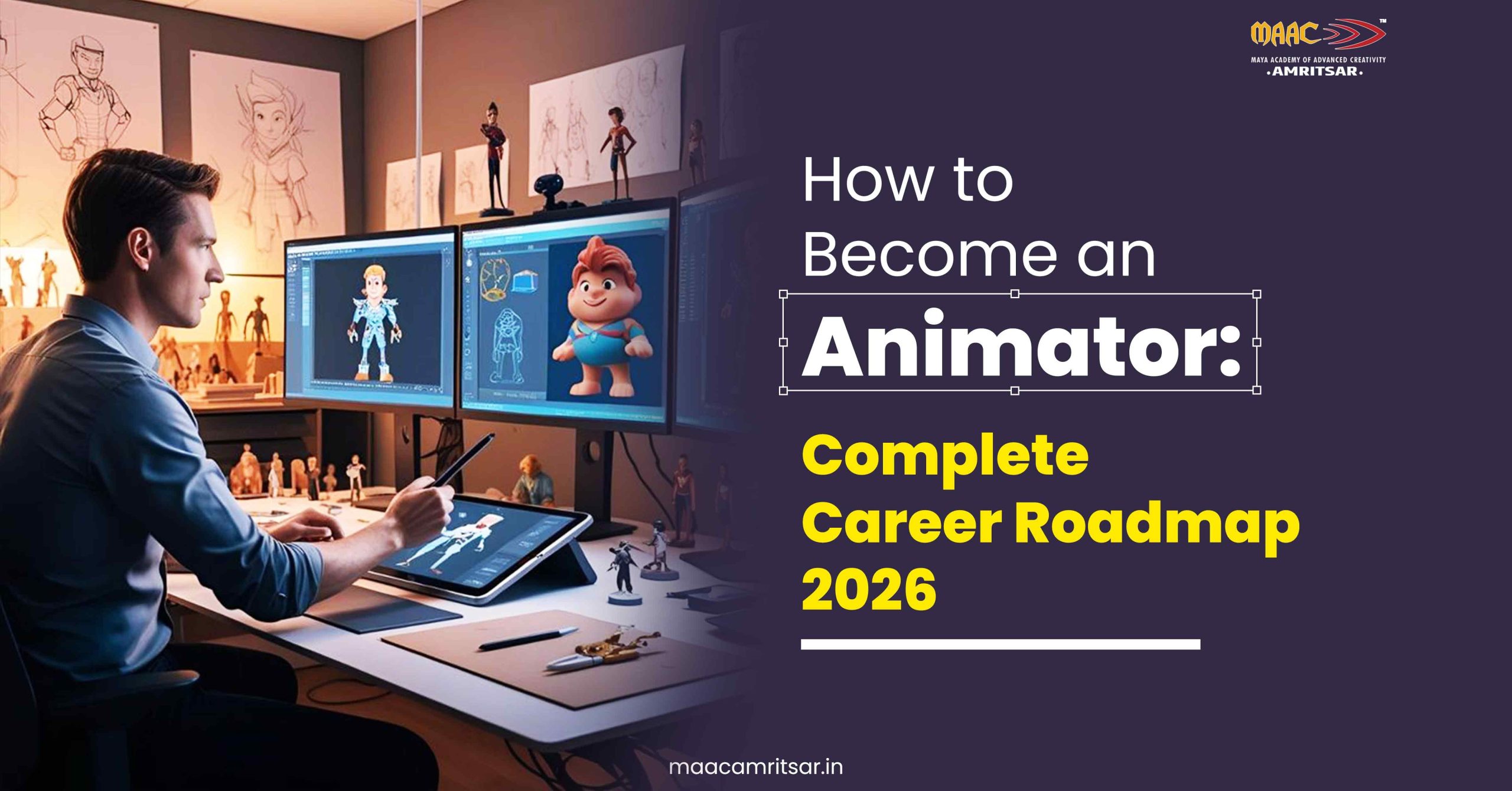
If you have ever sat through Pixar film, Netflix animated series, or watched jaw-dropping VFX sequence in Bollywood blockbuster and thought, ‘I want to make that’ then you are in the right place. The Indian animation industry is booming like never before. According to NASSCOM-FICCI report, India’s animation and VFX market is on track to cross $3 billion by 2026, making it one of the fastest growing creative sectors in the country. So if you have been wondering how to become an animator but did not know where to start then this article is everything you need.
We are going to guide you on complete career roadmap, from understanding what an animator actually does to the courses you should take, and the skills you will need to become an animator.
In this article, you will learn:
- What animators actually do
- Educational pathways to become an animator
- Complete career roadmap to become an animator
- Essential skills every animator needs
- Is animation good career choice in 2026? Real answer
- Why MAAC Amritsar is perfect option for animation training
What Animators Actually Do?
Animator creates movement, emotion, and visual storytelling through characters, objects, backgrounds, graphics, and digital scenes. In simple words animator brings still visuals to life. If you are thinking what is an animator, think of person behind animated films, cartoon characters, game movements, explainer videos, motion ads, product animations, and digital effects.
Now let’s answer what is animator job in practical way. Animator’s work include storyboarding, sketching poses, creating character movement, rigging models, adding keyframes, rendering scenes,and working with VFX teams. Their job role depends on type of animation.
- 2D animation artist works with flat drawings, frames, characters, and scenes.
- 3D animation artist works with digital models, rigs, textures, lighting, camera movement, and rendering.
- Stop motion animation artist creates movement by physically adjusting objects frame by frame.
There are many types of animation professionals in market today. You can become 2D animator, 3D animator, character animator, motion graphic designer, game animator, VFX artist, UI/UX animator, storyboard artist, lighting artist, rigging artist, and compositing artist. This is why career in animation gives you many directions to pursue.
Educational Pathways To Become An Animator
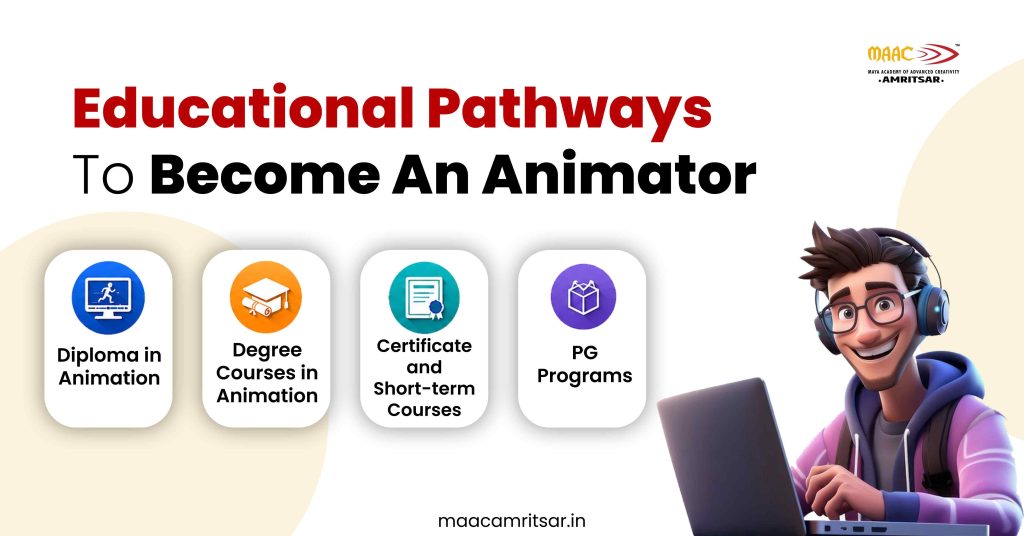
If you want to know how to become an animator, then you need to choose right path for yourself. Animation is all skill based career, in this career field you need practical knowledge of industry standard tools, and build strong portfolio. In this career, skills matter most rather than degrees.
Many students ask this question that how to become an animator after 12th? The good news is that you can start career in animation after 12th class from any stream. Here is list of main animation courses that you can choose according to your interest.
1. Diploma in Animation
Diploma usually takes 1 to 2 years to complete. It is useful for students who want job ready training in less time. Diploma may cover design basics, 2D animation, 3D animation, character animation, editing, modelling, rigging, and compositing.
Best for: Students who want to enter animation industry early and build portfolio while learning.
2. Degree Courses in Animation
Bachelors degree in animation takes 3 to 4 years to complete. These programs cover design theory, visual communication, animation production, film language, storytelling, and software training.
Best for: If you want higher studies, long-term career growth in design, filmmaking, gaming, and media production.
3. Certificate and Short-term Courses
Certificate programs are useful when you want to learn specific skill like Autodesk Maya, Blender, Adobe After Effects, Adobe Animate, Toon Boom Harmony, Cinema 4D, ZBrush, and Unreal Engine.
Best for: Short-term animation courses are also helpful for college students, working professionals, and beginners who want to test their interest before choosing full career program.
4. PG Programs
Postgraduate programs are useful for students who already know basics and want to specialise in character animation, VFX, game art, real time rendering, motion graphics, and advanced 3D production.
Complete Career Roadmap To Become an Animator
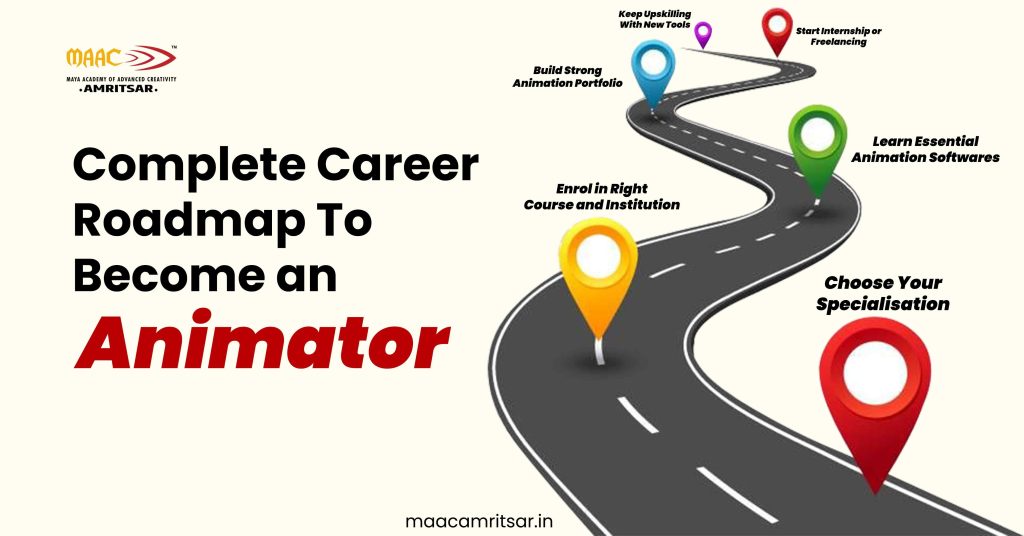
Here is honest and no fluff roadmap for how to become an animator. Follow these steps to build your career in animation.
Step 1: Choose Your Specialisation
The first step in how to become an animator is deciding your direction. There are different types of animation and each one has different skills set. You can choose
- 2D animation if you enjoy drawing, characters, frame by frame movement, cartoons, explainer videos, and visual storytelling.
- 3D animation if you like modelling, rigging, lighting, textures, realistic movement, films, games, and product visuals.
- Motion graphics if you enjoy typography, logo animation, brand videos, social media ads, and title design.
- VFX if you like compositing, green screen work, CGI, simulations, and film effects.
- Game animation if you are interested in gaming, character movement, action cycles, and real time engines.
Step 2: Enrol in Right Course and Institution
Next step for how to become an animator is looking for right place to learn. Do not select course by just checking course fees. You need to check:
- Do they teach industry standard tools
- Do they provide practical assignments
- Helps you in building strong animation portfolio
- Do they provide career guidance
Keep all these things in your mind when you are enrolling for animation course. Good animation institute provides you all of these things and placement support. For students searching for how to become animator after 12th, institutes like MAAC Amritsar can help you move from basic drawing and design to production level work step by step.
Step 3: Learn Essential Animation Software
Studios hire those artists who can work on real projects. That is why practical knowledge of animation tools is required. You can not build your career in animation without being fluent in the tools studios actually use.
Animation tools you need to learn:
| Animation type | Tools |
| 2D animation | Adobe Animate Photoshop Illustrator Toon Boom Harmony After Effects |
| 3D animation | Blender Cinema 4D Autodesk Maya ZBrush Unreal Engine |
| Motion Graphics | Premiere Pro After Effects Cinema 4D Illustrator |
Step 4: Build Strong Animation Portfolio
Your animation portfolio makes big impact instead of long resume because studios want skilled artists who know how to work with real projects. Your portfolio should include 30 to 60 second showreel showcasing your best work, range of styles such as character animation, motion graphics, and VFX depending on your specialisation, and don’t stuff it with all your work.
Step 5: Start Internship or Freelancing
Once your portfolio is built, you can start work as freelance or under studios. There are different platforms where you can find freelance work such as Upwork, Fiverr, Behance, LinkedIn,and through direct brand outreach. Beginner in animation career in India can start with junior animator, trainee animator, motion graphics designer, 3D modelling artist, storyboard artist, or VFX assistant roles.
Step 6: Keep Upskilling With New Tools
As you know future of animation is all about AI. AI in animation is now becoming creative part of workflow. But that does not mean AI steal your jobs, it just makes production faster. So thatswhy always keep yourself updated with new AI tools and animation software.
Essential Skills Every Animator Needs in 2026
Knowing how to become an animator is only part of the story. To build career in animation, only knowledge of animation tools is not enough. You have to excel in both technical and soft skills.
Soft Skills
Good animators are not only software operators. They are visual storytellers. You need to adapt these skills such as creativity, patience, observation, time management, problem-solving, client communication, and teamwork. Animation projects go through many revisions. So you should be open to feedback and ready to improve your work.
Technical Skills
The foundation starts with 12 principles of animation. They include timing, squash and stretch, anticipation, staging, arcs, exaggeration, appeal, and more. You also need strong animation skills like drawing basics, posing, anatomy, perspective, character movement, timing, spacing, acting, camera angles, and composition.
- For 3D animation you need to learn modelling, rigging, texturing, lighting, rendering, and compositing.
- For 2D animation, learn frame by frame animation, cut out animation, character design, clean up, and digital drawing.
Advanced Skills
Now animation skills also include prompt writing for AI tools, real time rendering, AR/VR animation, virtual production basics, and Unreal Engine workflows. These skills can help you stay relevant as future of animation becomes more connected with gaming, immersive media, AI assisted production, and interactive content.
Is Animation Good Career Choice in 2026? Real Answer
Animation career in India is not only limited to cartoons. Now animators work in every sector such as films, OTT, gaming, advertising, education, real estate, healthcare, apps, social media, and corporate videos.
Top industries hiring animation professionals include film studios, OTT platforms, gaming companies,and digital content agencies. India’s wider media and entertainment sector is also expanding. The FICCI-EY report said India’s media and entertainment industry reached ₹2.78 trillion in 2025 and is projected to grow to ₹3.3 trillion by 2028 which supports demand for creative and digital talent. Freelance and remote work are also growing. Many brands now need animated reels, explainer videos, product animations, YouTube intros, logo animations, and short form motion graphics.
Courses at MAAC Amritsar:
| Animation Course | What you will learn |
| 2D Animation Course | 1. Traditional animation principles and techniques. 2. Character design and development. 3. Digital 2D animation tools (Adobe Animate, Toon Boom Harmony). 4. Storyboarding and visual storytelling. 5. Background design and composition. 6. Animation timing and spacing. |
| 3D Animation and VFX | 1. 3D modeling and texturing. 2. Character rigging and animation. 3. Lighting and rendering techniques. 4. Particle systems and dynamics. 5. Compositing and post production. 6. Industry standard software like Maya, 3ds Max, and Blender. |
| Game Design and Development | 1. Game mechanics and gameplay design. 2. Character and environment modeling for games. 3. Real-time animation and optimization. 4. Game engines like Unity and Unreal. 5. Interactive storytelling techniques. 6. Level design and user experience. |
| Motion Graphics | 1. Typography and kinetic text. 2. Logo animation and brand identity. 3. Visual effects for video content. 4. Compositing and color correction. 5. Sound synchronization. 6. Software like After Effects and Cinema 4D. |
Animation students need practical knowledge more than theory and that is the reason to choose MAAC Amritsar. MAAC Amritsar provide:
- Experienced trainers and updated software infrastructure
- Regular masterclasses and workshops from industry experts on industry trends.
- Well furnished lab for students to gain practical knowledge.
- Strong portfolio building and placement support at top studios.
Conclusion
Now you know how to become an animator. From understanding what an animator does, to educational pathways, career roadmap, skills you will need and now you have everything you need to make clear and confident decisions about your future. We have covered almost all the ground that helps you to make your decision. Do not wait for right time, visit MAAC Amritsar to build your career in animation and future of animation is being built right now and it has room for you.
Leave a Reply