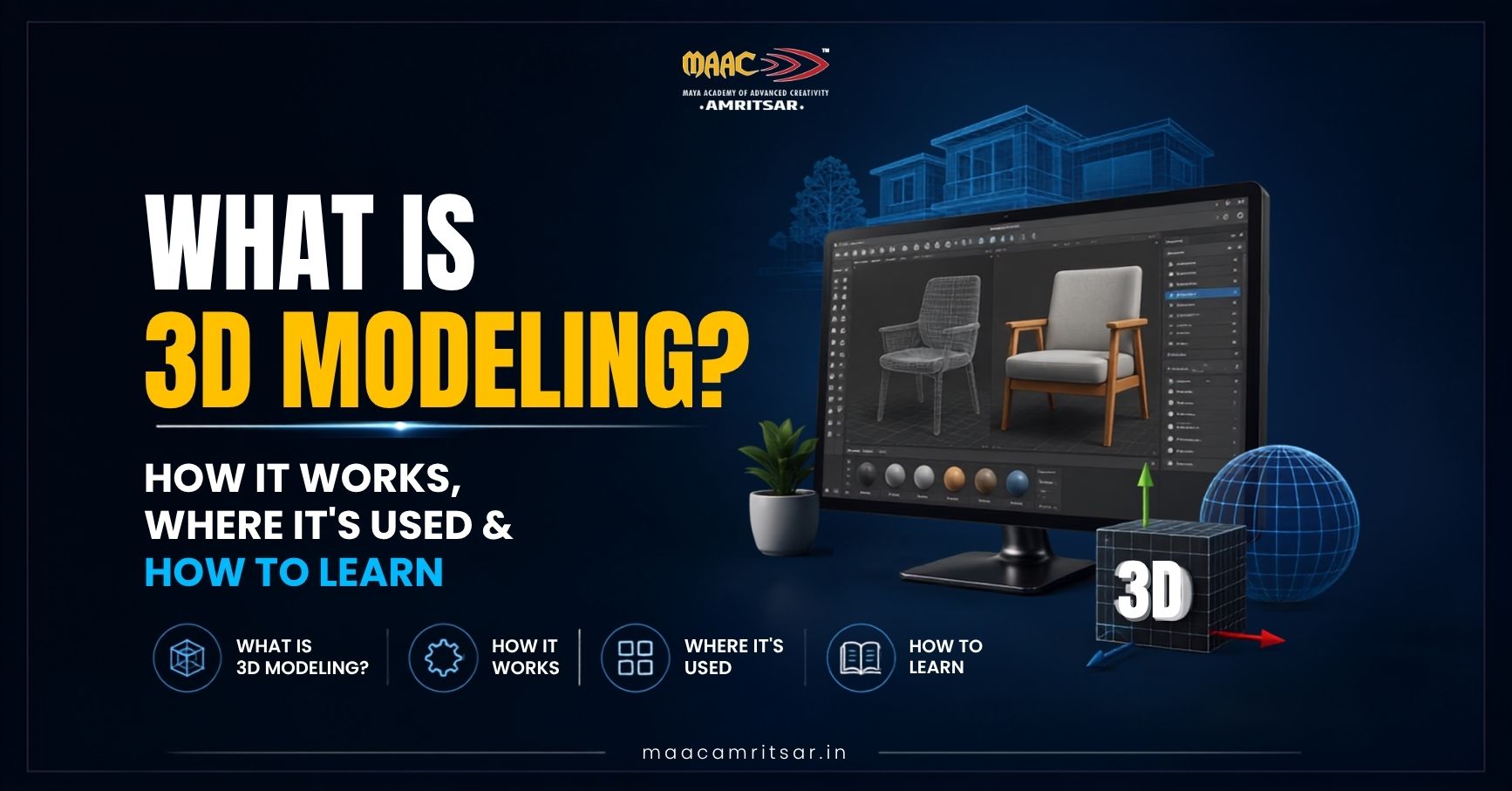
If you have ever watched animated movie, played video game or seen building ‘walkthrough’ before it was even built, you have seen results of 3D modeling. But did you ever think about what 3D modeling exactly is, how it works, and where it is used? Don’t worry, that is why we bring this article on what is 3D modeling with full guide for you to explain the concept.
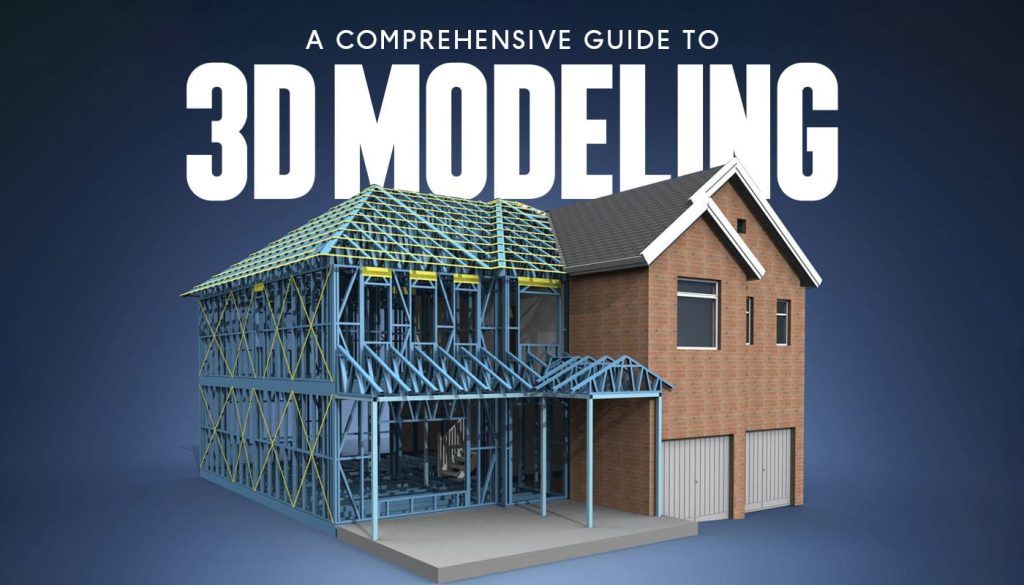
3D modeling is process of creating three dimensional representation on object or surface. 3D models are made with computer based 3D modeling software. The process of 3D modeling works with lines, polygons and points to create shapes within 3D modeling software.
Quick Answer:
| What is 3D modeling in simple words? In simple words, 3D modeling is digital process of shaping flat piece of virtual “clay” or geometry into recognizable object such as chair, face, car, building by using computer software instead of physical materials. The artist builds the shape point by point and surface by surface until it looks and behaves like the real thing on screen. If someone asks you what 3D modeling is in one sentence, that’s really the whole idea, turning empty digital space into shape that you can see, rotate, and use. |
In opposition to flat 2D drawing, 3D modeling can be viewed from different angles. Before using 3D object in project, artists can edit its form, proportions, size, features, and materials. It is essential part of the current world because so many fields nowadays create 3D designs before real-life examples appear.
- Architects visualize buildings before construction begins.
- Companies that manufacture products now create prototypes.
- Video game developers come up with entire worlds before even writing the code.
After you understand the concept of, it is easier to see that this field is an important one in the creative world.
How Does 3D Modeling Work?
Now this is heart of the topic. Because knowing what is 3D modeling only makes sense when you understand the 3D modeling process.
3D modeling involves the generation and modification of digital forms within various 3D programs. Artists typically start with basic shapes and forms, and they proceed with refining them and adding details in the process of preparing models for rendering, texturing, or any other purposes. The process is comprised of several steps rather than taking place in single event, and the following step builds upon the previous one.
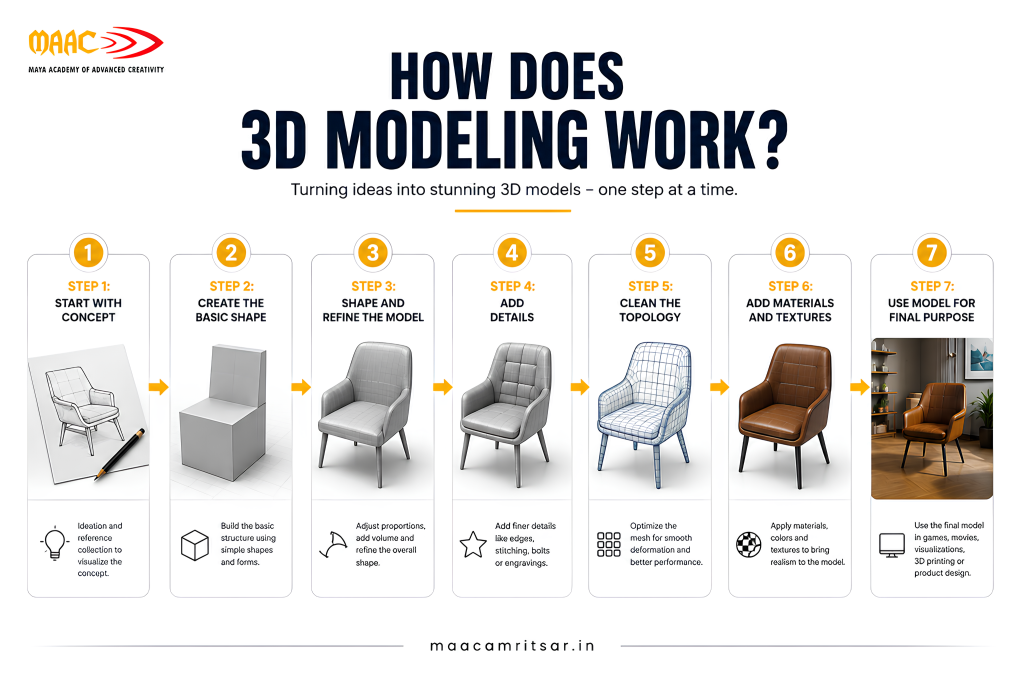
Step 1: Start With Concept
The majority of 3D models utilize images as source of reference as opposed to starting with an empty screen. Artists frequently rely on:
- Images designed by visual artists such as designers or illustrators
- Photographs or drawings taken from real life
- Design drafts of items or buildings
- Turnaround sheets depicting different perspectives of characters
This initial step plays important part in ensuring that the proper proportions and style are maintained well before artistic creation starts. Good references reduce guesswork and ensure the modeling process is more accurate.
Step 2: Create the Basic Shape
Now, the next step is to create basic mesh. Every 3D model starts with simple primary shapes such as
- Cube
- Cylinder
- Sphere
- Plane
Then these simple shapes can be transformed into much more complex forms. From here, artists use basic mesh creation and transformation tools to stretch, scale, and reposition these shapes into the rough outline of final object.
Step 3: Shape and Refine the Model
Once basic shape is ready, artists start refining it by using main modeling tools such as move, scale, rotate, extrude, inset, and loop cuts. For example, you are modeling chair by using cube. You could scale the cube to form the seat, extrude sections to create the legs, add loop cuts to control the shape, and bevel sharp edges.
Step 4: Add Details
After the main shape has been completed, artists apply techniques such as subdivision, sculpting, and Boolean operations to add the necessary details. For example, when creating model of game character, the sculpting work might concentrate on the character’s face and muscle definition but in case of modeling chair, there will be stitching details or patterns of carved wood. Moreover, model vehicle will be enhanced with panel lines, bolts, and machine details at this point.
Step 5: Clean the Topology
Artists define topology as the layout of edges and faces in the mesh, and they emphasize its importance in animation, object deformation, game asset production, and image rendering. A 3D model may look good when it is still, but it can fail catastrophically once animators bring it to life. This is where the technique of retopology plays its role. It allows the artist to form new and well suited mesh out of an existing detailed sculpture without losing the overall shape of object.
Step 6: Add Materials and textures
Now the role of materials and textures arrives. First you need to clear difference between three related but separate things. 3D model itself is just shape. Material controls properties such as how surface responds to light. Texture can provide visual information such as color, roughness, patterns, scratches, or other surface details. Modeling and texturing look like same task in this step but they are not. For example, 3D wooden table could have:
- Geometry that defines the shape.
- Material that controls how the wood reacts to light.
- Texture containing the wood grain.
Step 7: Use Model for Final Purpose
This final stage depends on the purpose of the model. This may involve:
- Animation for motion picture
- Rendering for an ad
- Importing into video game engine
- Applying in an architect’s presentation
- Using for VR/AR
- Preparing for 3D printing
- Applying for product visualization
What Are the Types of 3D Modeling?
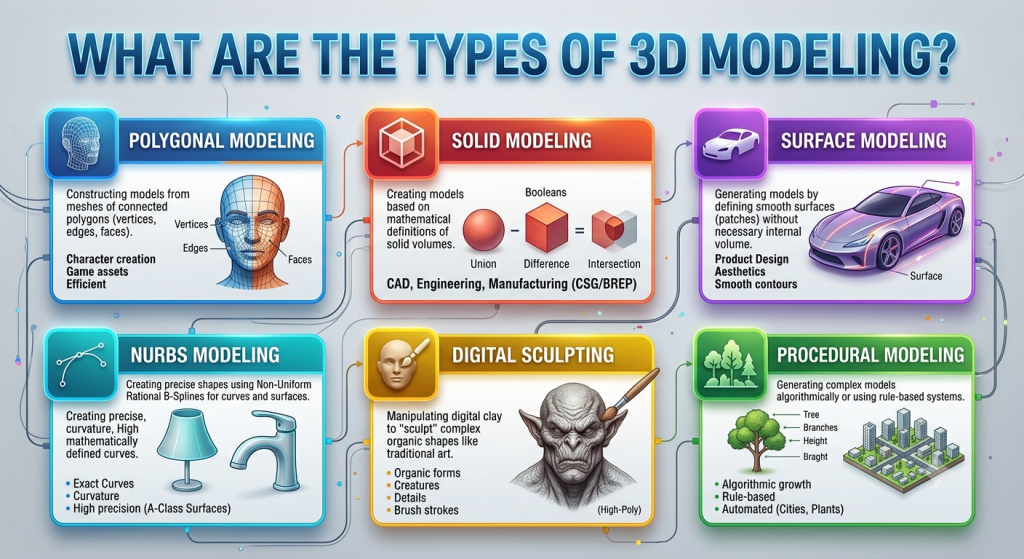
There are different types of 3D modeling and right approach depends on what you are creating. Animators and game developers commonly use polygonal modeling. Engineers and product designers use solid and surface modeling for technical and product‑oriented work. Artists use NURBS and sculpting when they need smooth curves and highly detailed organic forms.
| Types of 3D Modeling | Best For | Example |
| Polygonal Modeling | Games and animation | Game characters |
| Solid Modeling | Engineering and products | Mechanical component |
| Surface Modeling | Smooth product surfaces | Car body |
| NURBS Modeling | Precise curved objects | Industrial designs |
| Digital Sculpting | Organic characters | Human face |
| Procedural Modeling | Large or repeated environments | Digital city |
- Polygonal Modeling: This type of 3D modeling is the most used one when creating 3D models in games, animation, VFX and anywhere else where 3D production is needed. With polygonal modeling, only polygons are used to create models.
- Solid Modeling: This 3D modeling type produces solid objects based on mathematical definitions. In engineering and manufacturing industries, solid modeling is widely used because it provides accurate dimensions.
- Surface Modeling: Surface modeling deals with making smooth surfaces instead of solid objects. This modeling type is utilized in automotive and industrial design.
- NURBS Modeling: This modeling technique uses curves and surfaces that are smooth and mathematically defined. Because of these characteristics, it is perfect for all kinds of surface modeling jobs.
- Digital Sculpting: Digital sculpting is technique for organic modeling such as characters, creatures, and detailed surfaces that can be difficult to create using polygon modeling techniques.
- Procedural Modeling: Procedural modeling uses rules, nodes, or algorithms to automatically create models or even entire environments. It is particularly advantageous for models like cities, buildings, and landscapes, as the manual modeling of all objects would take an excessive amount of time.
6 Popular 3D Modeling Techniques Beginners Should Know
Beyond the basic types of 3D modeling, there are some specific 3D modeling techniques that artists use daily. These 3D modeling techniques may overlap with the types above we discussed but are worth learning individually because each one solves slightly different practical problems. Lets discuss 3D modeling techniques that you should know:
1. Box Modeling
Box modeling is the simplest form of 3D modeling techniques because it is easy to learn. The process is straightforward: one starts with cube, then adds edges, and pulls out the faces to bring out the shape until it becomes desired object. This method is widely employed in modeling furniture, vehicles, buildings, and hard surface gaming elements. It is typically the first method that beginners learn.
2. Digital Sculpting
Digital sculpting uses tools based on brushes in order to manipulate the so called digital clay. This method is suitable for making characters and creatures as well as for creating facial expressions and clothing details that do not necessarily require perfect geometry. Blender and ZBrush are widely used for this 3D modeling technique which provides specialized brushes and tools for sculpting high detail characters and creatures.
3. Extrusion Modeling
The essence of extrusion modeling is that the artist extends some of the existing faces to form new shape. For example, the artist may extrude the seat of the chair down to form the chair leg. This is also used to create architectural forms, vehicle parts, characters, props, and many other objects.
4. Boolean Operations
Process of Boolean operations helps combine or remove shapes from each other based on three basic operations: union, difference, and intersection. For example, it is possible to create perfect hole in mechanical shape by subtracting cylindrical shape from it, which would take too much time to create manually. The Boolean operations of this kind are frequently used by hard-surfaces artists because of the importance of getting accurate parts of machines, weapons, and vehicles.
In addition, Boolean operations may cause complications if the mesh background is not properly created, so retopology techniques are often used just after extensive Boolean operations.
5. Procedural Modeling
This is a technique rather than a separate kind of processing, which can be viewed as rule-based or node-based approach to modeling instead of working with already created geometry.
6. Retopology Techniques
Retopology techniques are those that should be employed by artists when they are aiming to remodel or to make the topology better, mainly in order to get mesh that might be animated later.
Where Is 3D Modeling Used? (Applications of 3D Modeling)
The applications of 3D modeling are not limited to films and video games only. Today, 3D models are also used in creative industries, engineering, advertising, manufacturing, architecture, media and visualization. When you understand what is 3D modeling then list of applications of 3D modeling will become less surprising and more inevitable.
3D Modeling Industry Use Cases:
| Industry | Use |
| Animation | Characters and environments |
| Gaming | Interactive assets and worlds |
| VFX | Digital objects and scenes |
| Architecture | Building visualization |
| Product Design | Prototypes and product concepts |
| Advertising | Product renders and campaigns |
| AR/VR | Immersive digital environments |
| 3D Printing | Physical objects created from digital models |
1. Animation and Films
In animation production pipeline, 3D modeling is important part. Artists use to create assets such as characters, buildings, vehicles, props, creatures and environments. Then these assets are rigged, textured and rendered. Every 3D object in animation scene needs to be modeled.
2. VFX
VFX artists use 3D modeling to create digital objects and environments that can be combined with live-action footage. For example, production required digital building and destroyed environment that is impossible to film physically. 3D models can be rendered, animated, and composited into final shot.
Also Read: 10 Best VFX Tools Used in Film, Gaming & Advertising (2026)
3. Game Design
Gaming is another important application of 3D modeling. Game artists create buildings, weapons, vehicles, props, environments and digital objects. 3D assets need to meet performance requirements because models need to be rendered in real-time.
4. Architecture and Interior Visualization
Architects and visualization artists use 3D models to showcase buildings and spaces to clients to show them how they will look before construction. This model can show:
- Exterior architecture
- Interior rooms
- Furniture
- Lighting
- Landscaping
- Building materials
5. Product Design and Manufacturing
Product designers use 3D modeling to create and modify product concepts before their final physical manufacturing. For example, furniture design, consumer electronics, packaging, mechanical components and automotive parts.
6. Advertising and Marketing
Now brands also use 3D modeling for product visualization, 3D advertisements, and motion graphics. Companies create 3D product models for social media campaigns instead of just using photography.
7. Virtual Reality and Augmented Reality
Virtual reality and augmented reality applications rely almost entirely on 3D models which serve as the building blocks for the digital settings and tangible things the users experience.
8. 3D printing system
Virtual models can be converted into real items through 3D printing technology, as the screen-based design transforms into reality.
How to Learn 3D Modeling: Courses and Career Path
Once you understand the concept and how it works, next you think about how you can learn 3D modeling. The good news is you don’t need to be expert artist before starting. You need patience, regular practice, and strong willingness to learn.
Self-taught vs. structured course
You can learn this skill by yourself through YouTube tutorials, documentation, and self practice. But honestly, teaching yourself through free tutorials is slower, and it is hard to build that kind of portfolio that studios are looking for. That is why well structured course gives you mentorship, clear learning path, and placement support after course completion. That matters a lot if you are aiming to get high paying salary job in 3D modeling.
What Good Course Should Cover?
Before enrolling in course, you need to look out for some important aspects. A good 3D modeling course includes:
- Proper software training
- Portfolio building projects
- Industry mentorship
- Internship/Placement Support
If you are in Amritsar and want hands-on training with placement support, you can look into the 3D modeling course details at MAAC Amritsar to see how their courses are structured.
FAQs
- Can I learn 3D modeling after 12th?
Yes. You can learn 3D modeling skills right after you pass your 12th. MAAC Amritsar provides professional courses that are suitable for students who have completed their 12th class.
- Is 3D modeling used in gaming?
Yes, game developers use 3D modeling techniques for the creation of characters, their surroundings, transport, props and other game components. However, it is essential to optimize these elements for real-time usage, thus giving importance to topology, polygon count, UV maps and textures.
- What is the difference between 2D and 3D modeling?
2D art is representation of items on a two-dimensional plane using length and width. 3D modeling adds depth, which means there is an object present in three-dimensional space. A 2D painting of chair would only show the item in single position, while 3D model of chair can be turned and viewed from different sides.
- Is 3D modeling easy to learn?
Learning 3D modeling is not such complex task. You just need patience, regular practice and strong willingness to learn 3D modeling skills.
- Which software do professionals mostly use for 3D modeling?
Blender is strong general starting point because it is free and includes modeling, sculpting, animation, rendering, and other tools.
Leave a Reply